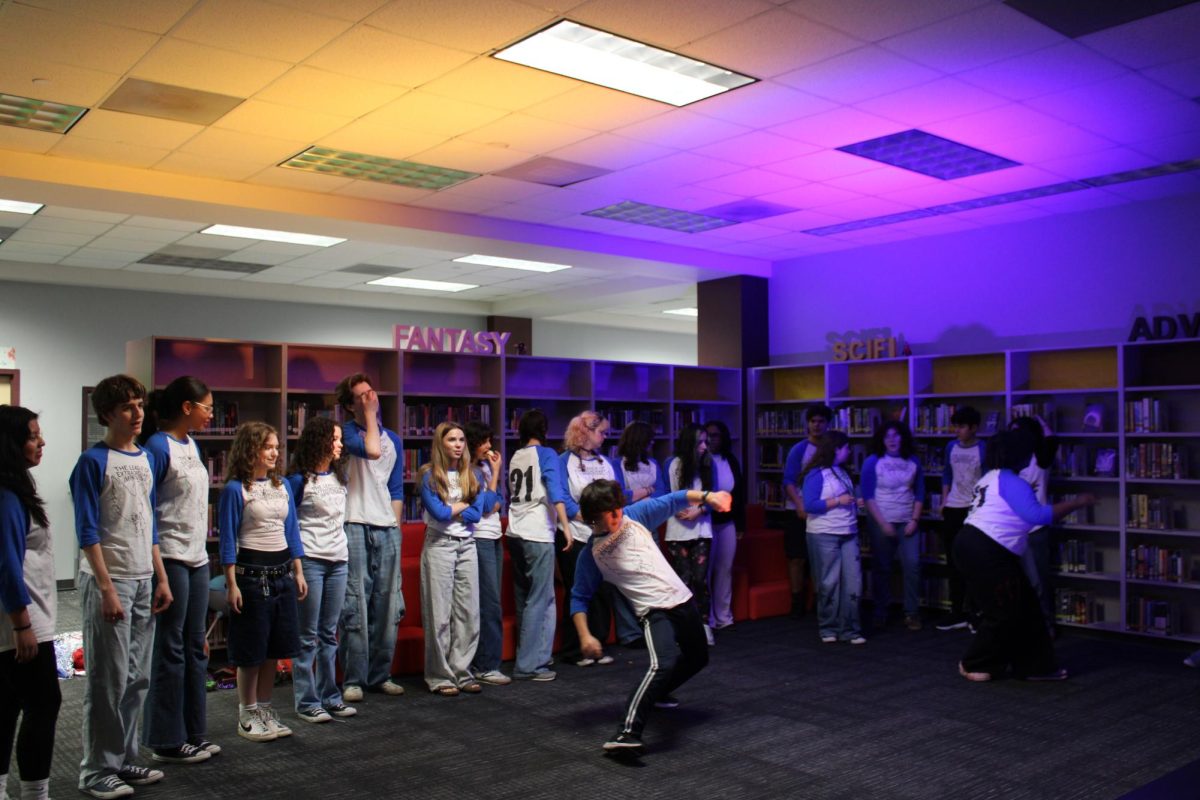











“Just jump right in. The class is super inviting in terms of welcoming people to try it. You can watch, you can learn, you can take in, and you can perform when you’re ready to,” says B.P. Newport, a veteran member of Theatre Production: Improvisation, about the performance-based class. Improv is a category of theatre arts that orbits around spontaneity and comedy as opposed to script memorization. Our school’s LExI (League of Extraordinary Improvisors) chapter meets everyday in K108 to conduct business.
Business for LExI generally remains the same every day: rapid fire warm-up games to begin the class with, straight into a volunteering-centric improv game, followed by a brief critique from non participating students, repeated until the bell. What keeps the class fascinating despite its structuredness is the students’ ability to create multiple unique and distinct scenes with different prompts, characters, and quirks, an improv term for a weird or eccentric trait ascribed to a certain character (ie: the inability to stop coughing, the state of being a multitool, speaking in a baby voice).
Improv is comprised of various games that fall into five categories: scene-based, line-based, mid-form, guessing, and long-form.
An example of a guessing game is “Dating Game”, in which three improvisers (the contestants) are assigned different quirks while one improviser (the bachelor) is ushered out of hearing range. When the bachelor returns, the contestants will ask him questions that hint at their quirks. The game ends after the bachelor correctly guesses each quirk and picks a contestant to “win” the dating game.
An example of a line-based game is “Freeze”. In Freeze, all of the improvisers assemble in a line with two improvisers stepping up to begin a scene any way they’d like. However, at any time, an improviser from the line may step into the scene, tap one of them on the shoulder, and say “freeze!”, replacing the prior performer in the scene.

Overall, improv is a fantastic setting to learn the art of comedy, charisma, wit, and agreement. As an improviser, one of the most important skills is being able to build off what your co-performers are saying without negating their input, even if you had a different vision for how the scene would play out. Mutual respect is a key component here. Otherwise, the class is relatively lax and welcoming no matter what.
Outside of classwork, LExI also hosts a variety of different performances, including four “LExI in the Library” shows that take place during all lunch periods, four auditorium shows outside of school hours, and occasionally, collaborative shows with improv troupes from other schools in the district. “LExI in the Library” is the troupe’s way of introducing improv to students during school for no price at all. The library performances are usually moodier and feature dynamic LED lighting, creating a very chill atmosphere that the comedy can break through. According to Eliana Oliver (10), LExI in the Library is the most effective promotional tactic that the troupe uses to get students to come to auditorium shows.
LExI’s auditorium shows often span two hours with a 15-minute intermission and an auction for the troupe-signed show poster. Newspaper and Yearbook teacher Jeffrey Hebert says, “The [auditorium] shows are my favorite extracurricular at Creek because of the spontaneous nature of improv. The kids get to be witty, and clever, and they’re always really funny”.
The auditorium shows allow the troupe to take a larger stage, where they can employ a wider range of objects and skits and use technology such as the lighting and sound board. This creates opportunities for students who don’t get cast in the show to take a behind the scenes tech role or a host role, which means that they will be on stage announcing the games and ringing the bell when the game calls for it. For those who do get cast in the show, it is truly an experience.
Freshman Gonzalo Hanley says, “It’s scary to be up there, but it’s really fun when you are. You never know what you’re gonna do,” about the show experience. “It’s like a thrill, it’s extremely fun”.